


About PTC
PTC is an abbreviation for Positive Temperature Coefficient, generally referring to semiconductor materials or components with a large positive temperature coefficient. Usually, when we mention PTC, we are referring to Positive Temperature Coefficient Thermistors, commonly known as PTC thermistors. PTC thermistors are a type of semiconductor resistor with temperature sensitivity, and when the temperature exceeds a certain threshold (Curie temperature), their resistance increases abruptly with temperature rise.
The Organization Structure and Functional Principle
Ceramic materials are commonly used as excellent insulators with high resistance. Ceramic PTC thermistors are made using barium titanate as a base and doped with other polycrystalline ceramic materials, resulting in lower resistance and semiconductor characteristics. This is achieved through intentional doping of a chemical element with a higher valence as a lattice point of the crystal. Part of the barium ions or titanate ions in the lattice is replaced by the higher valence ions, creating a certain number of free electrons that contribute to electrical conductivity.
The reason for the PTC (Positive Temperature Coefficient) effect, i.e., the abrupt increase in resistance, lies in the material's organization, which consists of many small microcrystals. At the interfaces of these crystals, known as grain boundaries, barriers are formed, hindering the movement of electrons into adjacent regions. As a result, the resistance becomes high. This effect is offset at low temperatures due to the high dielectric constant and spontaneous polarization strength at the grain boundaries, which prevent the formation of barriers and allow electrons to flow freely. However, at high temperatures, the dielectric constant and polarization strength significantly decrease, causing the barriers and resistance to increase sharply, exhibiting a strong PTC effect.
Manufacturing Process of PTC Thermistors
Weighing and Mixing: The materials, such as barium carbonate, titanium dioxide, and other additives, are accurately weighed and mixed to achieve the required electrical and thermal properties.
1. Wet Grinding: The mixture undergoes wet grinding to form a uniform paste.
2. Dehydration and Drying: The paste is then dehydrated and dried to remove excess moisture.
3. Dry Pressing: The dried material is dry-pressed into various shapes, such as disks, rectangles, rings, or honeycomb structures.
4. Sintering: The pressed blanks are sintered at a high temperature (around 1400°C) to form ceramic components.
5. Electrode Application: Electrodes are applied to the surface of the ceramic components to make them conductive.
6. Resistance Sorting: The components undergo resistance sorting to classify them based on their resistance values.
7. Wire Bonding: Depending on the final product's structure, wire bonding is performed to connect the components.
8. Insulation Encapsulation: The components are enclosed in insulating material for protection.
9. Assembly: The components are assembled, and if required, they are placed in protective casings.
10. Withstand Voltage Testing: The assembled PTC thermistors undergo withstand voltage testing to ensure their electrical safety.
11. Resistance Testing: The resistance of the PTC thermistors is checked to verify their performance.
12. Final Testing: Comprehensive testing is conducted to evaluate the overall functionality of the PTC thermistors.
13. Packaging: The tested and approved PTC thermistors are packaged for shipment.
14. Storage: The packaged PTC thermistors are stored in a suitable environment until they are distributed or used in various applications.
R-T Characteristic
PTC thermistors exhibit a temperature-dependent relationship between resistance and temperature, commonly known as the Resistance-Temperature (R-T) characteristic. The R-T characteristic describes the dependency of the zero-power resistance of the PTC thermistor on its temperature, under a specified voltage.
The zero-power resistance refers to the resistance value of the PTC thermistor when measured at a certain temperature, with a very low applied power, so low that the resistance change caused by the power dissipation can be neglected. The rated zero-power resistance represents the value measured at an ambient temperature of 25°C.
-
Rmin: minimum resistance
-
Tmin: Temperature in Rmin
-
Rtc: 2 times of Rmin
-
Tc:
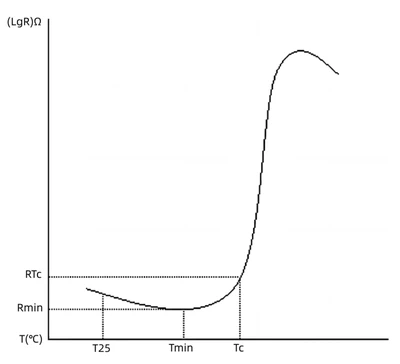
The key parameter that characterizes the quality of the R-T characteristic is the temperature coefficient (α), which reflects the steepness of the R-T curve. A higher temperature coefficient (α) indicates that the PTC thermistor is more sensitive to temperature changes, resulting in a more pronounced PTC effect. In other words, a higher temperature coefficient means better performance and longer lifespan for the PTC thermistor.
The temperature coefficient (α) of a PTC thermistor is defined as the relative change in resistance caused by a temperature change. It can be calculated using the formula: α = (log(R2) - log(R1)) / (T2 - T1)
Usually, T1 is taken as Tc + 15°C, and T2 is taken as Tc + 25°C, where Tc is the Curie temperature of the PTC thermistor.
V-I Characteristic
The Voltage-Current (V-I) characteristic, also known as the current-voltage characteristic or simply the V-I characteristic, illustrates the interdependency between voltage and current in a PTC thermistor when it reaches thermal equilibrium under electrical load.
-
Ik: Operating current at applied voltage Vk
-
Ir: Residual current when Vmax is applied
-
Vmax: Maximum voltage
-
VN: Norminal voltage
-
VD: Breakdown Voltage

The V-I characteristic of a PTC thermistor can generally be divided into three regions:
Linear Region (0-Vk): In this region, the relationship between voltage and current follows Ohm's law, and there is no significant non-linear variation. It is also known as the non-action region because the PTC thermistor does not exhibit any noticeable changes in its resistance.
Transition Region (Vk-Vmax): In this region, known as the transition or switching region, the resistance of the PTC thermistor undergoes a rapid change due to self-heating. As the voltage increases, the current decreases, resulting in the PTC thermistor switching from a low-resistance state to a high-resistance state. This region is also referred to as the action region.
Breakdown Region (VD and above): In this region, known as the breakdown or tripping region, the current increases with an increase in voltage. The resistance of the PTC thermistor exhibits an exponential decrease, resulting in higher currents for higher voltages. As a consequence, the temperature of the PTC thermistor rises, leading to a further decrease in resistance. Eventually, this can cause thermal breakdown or tripping of the PTC thermistor.
The V-I characteristic is an important reference for overcurrent protection provided by PTC thermistors. It helps determine the behavior of the thermistor under different voltage and current conditions, ensuring effective protection against excessive current flow.
T-t Characteristic

Current-Time Characteristic refers to the characteristic of a PTC thermistor where the current changes with time during the application of voltage.
When voltage is initially applied to the PTC thermistor, the current at that moment is called the Starting Current. As the PTC thermistor reaches thermal equilibrium, the current that remains is referred to as the Residual Current.
At a certain ambient temperature, when an initial current (ensuring it is the operating current) is applied to the PTC thermistor, the time taken for the current to decrease to 50% of the starting current is called the Response Time or Response Time Constant. The current-time characteristic is an important reference for various applications of PTC thermistors, such as automatic demagnetization, delayed startup, and overload protection.


